PReCCL: Performant and Resilient Collective Communication via Integrated Inband Telemetry and Workload ReallocationPReCCL:結合頻內遙測與工作量重新分配的高效能、具韌性集體通訊
After reading, you can explain how PReCCL measures each NCCL channel's progress from inside the library and moves bytes away from a slow or failed path at every collective boundary.讀完後,你能說明 PReCCL 如何在函式庫內部量測每個 NCCL channel 的進度,並在每次集體操作的邊界,把位元組從變慢或故障的路徑移走。
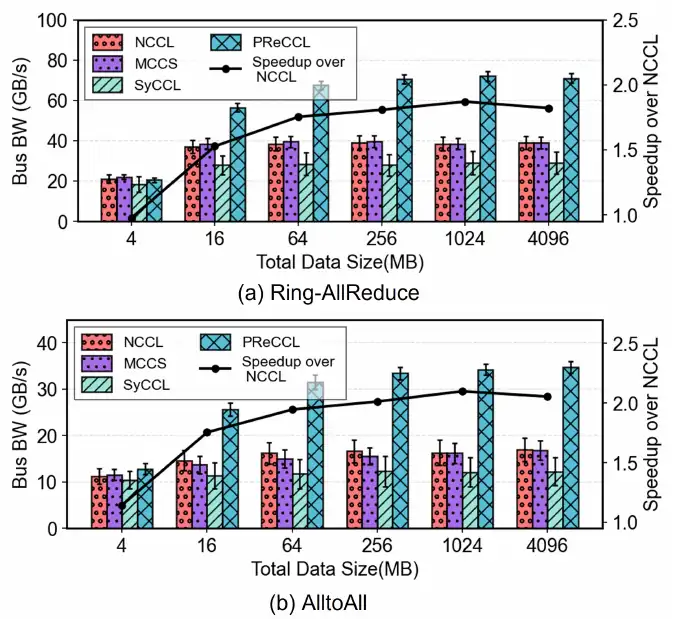
NCCL splits every collective into channels, here called virtual topologies (VTs), over different NICs and paths, and gives each the same bytes: one congested VT sets the completion time, and a dead NIC aborts the job. PReCCL, a drop-in NCCL replacement, counts how often each VT's sender waits for FIFO credit, shares the counts on the collective's own traffic, and at every collective boundary lets all ranks compute the same new byte split. A failed NIC becomes a VT with zero bytes. On a 32-GPU testbed shared by three jobs, it raised bus bandwidth 1.8× (Ring-AllReduce) and 2.1× (AlltoAll) above 64 MB and made training 1.18–1.21× faster; in a separate fault test it kept 78% of bus bandwidth after one of eight NICs failed, where NCCL aborted.
NCCL 把每次集體操作拆成多個經由不同 NIC 與路徑的 channel(本論文稱為虛擬拓樸,VT),並給每個一樣多的位元組:一個壅塞的 VT 就決定完成時間,一張壞掉的 NIC 會讓任務中止。PReCCL 可直接替換 NCCL:它計算每個 VT 的送端等待 FIFO credit 的次數,把計數搭在集體操作自己的流量上分享,並在每次集體操作的邊界讓所有 rank 算出相同的新位元組分配。故障的 NIC 變成分到零位元組的 VT。在三個任務共用的 32 GPU 測試平台上,它讓 64 MB 以上的 bus bandwidth 提高 1.8 倍(Ring-AllReduce)與 2.1 倍(AlltoAll),訓練快 1.18–1.21 倍;在另一個故障實驗中,它在八張 NIC 壞一張時保有 78% 的 bus bandwidth,而 NCCL 直接中止。
1. Where this paper sits1. 這篇論文的位置
Section 4.5 shows NCCL's channels: each is one CUDA block with its own staging FIFO, and different channels leave through different NICs. NCCL cuts the message into equal parts, one per channel. Section 8 defines bus bandwidth (busbw), and section 9 ends with a theme: decide at run time what the host cannot know in advance. PReCCL applies that theme to the channel split. A collective communication task (CCT) is one call of a collective; each sub-task (channel) follows a VT, an ordered graph of GPUs on particular NICs; in AlltoAll, a VT is one GPU pair. The Theseus digest swaps whole schedules at run time; PReCCL keeps the schedule and changes how many bytes each VT carries.
第 4.5 節畫出 NCCL 的 channel:每個是一個帶有自己暫存 FIFO 的 CUDA block,不同 channel 經由不同 NIC 出去。NCCL 把訊息切成相等的幾份,每個 channel 一份。第 8 節定義 bus bandwidth(busbw),第 9 節以一個主題作結:在執行時決定主機事先無法知道的事。PReCCL 把這個主題用在 channel 的分配上。集體通訊任務(CCT)是一次集體操作呼叫;每個子任務(channel)沿著一個 VT 前進,也就是一張在特定 NIC 上的有序 GPU 圖;在 AlltoAll 中,一個 VT 是一對 GPU。Theseus 導讀在執行時抽換整個排程;PReCCL 則保留排程,改變每個 VT 承載的位元組數。
2. The problem, measured2. 問題,用量測說話
A collective ends when its slowest VT ends. If VT carries of the bytes at bandwidth :
集體操作在最慢的 VT 結束時才結束。若 VT 以頻寬 承載 位元組中的 :
NCCL's equal split, , takes ; the split makes every VT finish at the minimum (Appendix A). In the paper's example, two VTs at 200 and 50 Gb/s finish 2.5× sooner with a 4:1 split than with 1:1 (Figure 1).
NCCL 的均分 需要 ;分配 讓每個 VT 都在最小值 完成(附錄 A)。在論文的例子中,兩個 VT 分別為 200 與 50 Gb/s,4:1 分配比 1:1 快 2.5 倍完成(圖 1)。
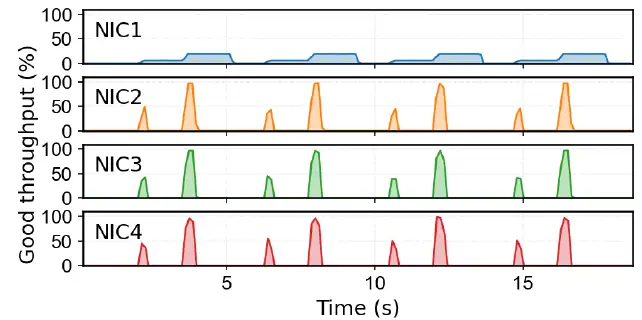
A measured trace shows the effect (Figure 2): with NIC1 congested, NIC2–NIC4 finish their shares quickly and wait. Two weeks of traces from a large public cloud's multi-tenant GPU clusters show many training jobs sharing a physical link with another job, and Alibaba HPN reported 1–2 job crashes per month from timeouts caused by faulty NICs.
一筆實測紀錄顯示了這個效應(圖 2):NIC1 壅塞時,NIC2–NIC4 很快送完自己那份,然後等待。某大型公有雲多租戶 GPU 叢集兩週的紀錄顯示,許多訓練任務與另一個任務共用實體鏈路;Alibaba HPN 也報告,壞掉的 NIC 造成的逾時每月導致 1–2 次任務崩潰。
Existing answers do not see the VT: congestion control and load balancing act on one flow or packet, solvers such as SyCCL plan before the job, and MCCS and FuseLink adapt GPU order or NICs without moving bytes between VTs. The paper's 512- and 1,024-GPU simulations are not quoted here.
現有的做法都看不到 VT:壅塞控制與負載平衡作用在單一 flow 或封包,SyCCL 等求解器在任務開始前規劃,MCCS 與 FuseLink 調整 GPU 順序或 NIC,卻不在 VT 之間搬移位元組。論文 512 與 1,024 GPU 的模擬,這裡不引用。
3. The design3. 設計
PReCCL never creates or destroys connections or channels. It changes only byte ranges (Ring, Tree) or relay choices (AlltoAll).
PReCCL 從不建立或拆除連線與 channel。它只改變位元組範圍(Ring、Tree)或轉送的選擇(AlltoAll)。
3.1 One contiguous block per VT3.1 每個 VT 一段連續區塊
NCCL interleaves: each loop step is cut into one chunk per VT, so all VTs advance through one ring together and none can finish early (Figure 3a). PReCCL gives each VT one contiguous block and runs an independent ring on it (Figure 3b). With this path isolation, a VT finishes when its own block is done, bytes can move between VTs without loss (Figure 3c), and each progress signal belongs to one VT.
NCCL 採交錯配置:每個迴圈步驟切成每個 VT 一個 chunk,所以所有 VT 一起走同一個環,誰都不能提早結束(圖 3a)。PReCCL 給每個 VT 一段連續區塊,並在上面跑一個獨立的環(圖 3b)。有了這種路徑隔離,VT 在自己的區塊做完時就結束,位元組可以在 VT 之間無損地移動(圖 3c),每個進度訊號也只屬於一個 VT。
3.2 Measure each VT by its FIFO stalls3.2 以 FIFO 停頓量測每個 VT
The sender at the head of a VT advances a FIFO's tail pointer, and the receiver at the far end advances the head pointer: the slot and credit mechanism of Section 4.5. When any hop slows (NVLink, PCIe, NIC, switch), the FIFO fills and the sender waits; while waiting, its GPU threads increment a shared-memory counter (Figure 4). The count covers the whole path and costs almost nothing. Direct timing was rejected because SM clocks are not synchronized. PReCCL converts the count for bytes into a time:
VT 起點的送端推進 FIFO 的 tail 指標,遠端的收端推進 head 指標:這就是第 4.5 節的槽與 credit 機制。任何一跳變慢(NVLink、PCIe、NIC、交換器),FIFO 就會填滿,送端只能等待;等待時,它的 GPU 執行緒會遞增一個共用記憶體計數器(圖 4)。這個計數涵蓋整條路徑,幾乎不花成本。直接計時被捨棄,因為 SM 的時脈不同步。PReCCL 把 位元組對應的計數 轉成時間:
Here prices a stall, a byte and fixed overhead. Fitted on more than 30,000 samples, the model explains 94% of the variance in sub-task time, and it is refit online every 10 s. The counts ride on the collective's own data: bytes per CCT, 4 KB for 256 GPUs with 16 VTs.
其中 是停頓的代價, 是每位元組的代價, 是固定開銷。以超過 30,000 個樣本擬合,這個模型解釋了子任務耗時 94% 的變異,並每 10 s 線上重新擬合。計數搭在集體操作自己的資料上:每個 CCT 位元組,256 顆 GPU、16 個 VT 時是 4 KB。
3.3 Rebalance at the CCT boundary3.3 在 CCT 邊界重新平衡
Each CCT has an epoch number and a fixed allocation . Its last synchronization step carries the epoch-tagged counts; every rank checks the epoch, VT count and checksum, then computes with a deterministic function (fixed VT order, ties to the lower ID, integer rounding). No extra round trip is needed. The update comes from TeXCP, a 2005 traffic-engineering controller. With shares and mean time :
每個 CCT 有一個 epoch 編號 與固定的分配 。它最後一次同步步驟帶著標上 epoch 的計數;每個 rank 核對 epoch、VT 數與校驗和,然後以確定性函式(固定 VT 順序、平手取較小 ID、整數捨入)算出 ,不需額外往返。更新規則來自 2005 年的流量工程控制器 TeXCP。設占比 、平均時間為 :
Slower-than-mean VTs lose bytes and faster ones gain, in a coordinated way, so the moves do not oscillate as per-VT AIMD does. Appendix A proves convergence to for fixed , but the rule has four gaps:
比平均慢的 VT 失去位元組、較快的得到,而且彼此協調,所以不會像各 VT 獨立的 AIMD 那樣擺盪。附錄 A 證明在 固定時會收斂到 ,但這條規則有四個缺口:
- Units. has no unit and is a time, so is in seconds, not bytes. The appendix's step size ("implicitly 1") must carry bandwidth units, and its real value is not stated.單位。 沒有單位, 是時間,所以 的單位是秒而不是位元組。附錄的步長 (「隱含為 1」)必須帶有頻寬單位,實際數值沒有說明。
- Mean. The main text uses the plain mean, the appendix the share-weighted one; only the weighted mean makes the moves sum to zero.平均。正文用單純平均,附錄用依占比加權的平均;只有加權平均能讓移動總和為零。
- makes the slowest VT lose slightly fewer bytes; the paper gives no value. 讓最慢的 VT 少失去一點位元組;論文沒有給數值。
- Rate. The appendix bounds the imbalance to shrink by at least per step, , and claims more than 90% within 5 steps for , . The bound gives only about 15% (table below).速率。附錄給出不平衡度 每步至少縮小為 倍的上界,,並宣稱在 、 時 5 步內減少 90% 以上。這個上界只給出約 15%(見下表)。
| Question問題 | Calculation算式 | Result結果 |
|---|---|---|
| Guaranteed factor per step, , 每步保證的倍數,、 | ||
| Imbalance left after 5 steps5 步後剩下的不平衡度 | a 15% reduction, not 90%只減少 15%,不是 90% | |
| Steps the bound needs for a 90% reduction這個上界要減少 90% 所需的步數 | steps步 |
The panel runs this rule with the missing scale made explicit.
面板以明確補上的比例執行這條規則。
3.4 AlltoAll relays and failures3.4 AlltoAll 的轉送與故障
AlltoAll. Each AlltoAll VT serves one source–destination pair, so bytes cannot simply move to another VT. PReCCL relays part of a slow pair's bytes through one other GPU in the same node, over NVLink, which leaves candidates on 8-GPU nodes. It rejects a relay whose cost exceeds the direct cost; on the testbed, relay was active in 23% of CCTs during congestion. Unlike NVIDIA's static PXN proxy, it picks the relay per CCT.
AlltoAll。每個 AlltoAll VT 服務一對特定的來源與目的地,位元組不能直接移到別的 VT。PReCCL 把慢的那一對的部分位元組,經 NVLink 由同一節點的另一顆 GPU 轉送,在 8 GPU 節點上候選有 個。轉送成本超過直接傳送時就放棄;在測試平台上,壅塞期間 23% 的 CCT 啟用轉送。與 NVIDIA 靜態的 PXN 代理不同,它每個 CCT 重新選擇轉送對象。
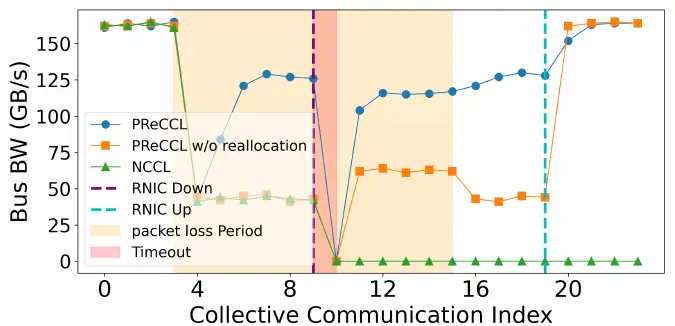
Failures. Degradation, such as a weak fiber, only slows VTs. When a NIC, optical module or switch port dies, PReCCL catches NCCL's timeout before it reaches the framework, broadcasts the failure over a socket channel, gives the dead VT zero bytes, spreads its share and re-runs the CCT (Figure 5). A probe at the start of each later CCT detects recovery. Losing all VTs, such as a GPU failure, still means checkpoint restart.
故障。劣化,例如光纖訊號變弱,只會讓 VT 變慢。當 NIC、光模組或交換器埠壞掉時,PReCCL 在 NCCL 的逾時傳到框架之前攔下它,經 socket 通道廣播故障,不再分給壞掉的 VT 任何位元組,把它那份分掉,並重跑 CCT(圖 5)。之後每個 CCT 開始時的探測會發現它已恢復。所有 VT 都失效時,例如 GPU 故障,仍須從檢查點重啟。
4. Implementation4. 實作
PReCCL is about 3,000 lines of C++ on NCCL v2.29, loaded through an environment variable with no framework change. Reallocation is off for small collectives: startup nccl-tests pick the smallest message whose latency is within 2% of NCCL's, which for 32 GPUs is 32 MB (Ring) and 8 MB (Tree). Below that, PReCCL behaves exactly like NCCL.
PReCCL 是建在 NCCL v2.29 上、約 3,000 行的 C++,以環境變數載入,不必修改框架。小型集體操作不做重新分配:啟動時的 nccl-tests 選出延遲與 NCCL 相差不到 2% 的最小訊息,32 顆 GPU 時是 32 MB(Ring)與 8 MB(Tree)。低於門檻時,PReCCL 的行為與 NCCL 完全相同。
5. What was measured5. 量到了什麼
The testbed has 4 servers with 8 Hopper GPUs and 8 ConnectX-7 400 Gb/s NICs each. Each server has its own top-of-rack (ToR) switch and 2 spines join them, so every inter-server flow crosses a spine. Three jobs share it: Qwen-MoE on 4 GPUs per server, GPT and BERT on 2 each. Baselines are NCCL v2.29, SyCCL and MCCS (Figure 6).
測試平台有 4 台伺服器,每台有 8 顆 Hopper GPU 與 8 張 400 Gb/s 的 ConnectX-7 NIC。每台伺服器有自己的機櫃頂端(ToR)交換器,由 2 台 spine 連接,所以每條跨伺服器 flow 都經過 spine。三個任務共用平台:Qwen-MoE 每台用 4 顆 GPU,GPT 與 BERT 各用 2 顆。基準是 NCCL v2.29、SyCCL 與 MCCS(圖 6)。
| Test測試 | Setup設定 | Measured實測結果 |
|---|---|---|
| Training訓練 | 3 jobs on the testbed測試平台上 3 個任務 | 1.19× GPT (median 2.0 → 1.68 s), 1.21× Qwen-MoE (1.27 → 1.05 s), 1.18× BERT (0.71 → 0.60 s)GPT 1.19 倍(中位數 2.0 → 1.68 s)、Qwen-MoE 1.21 倍(1.27 → 1.05 s)、BERT 1.18 倍(0.71 → 0.60 s) |
| Collectives集體操作 | same, above 64 MB同上,64 MB 以上 | busbw 1.8× NCCL (Ring-AllReduce), 2.1× (AlltoAll)busbw 為 NCCL 的 1.8 倍(Ring-AllReduce)、2.1 倍(AlltoAll) |
| Overhead開銷 | no contention, 64 MB無競爭,64 MB | 0.11% (AlltoAll), 0.97% (Ring/Tree)0.11%(AlltoAll)、0.97%(Ring/Tree) |
| Signal訊號 | 256 MB, 16 GPUs256 MB、16 顆 GPU | Direct timing: 53% (Ring) and 46% (AlltoAll) slower medians直接計時:中位數慢 53%(Ring)與 46%(AlltoAll) |
| TeXCP vs AIMDTeXCP 對 AIMD | congestion in CCTs 11–20 of 3030 個 CCT 中第 11–20 個壅塞 | TeXCP 78.5 → 125.1 GB/s, then 167 GB/s within 3 CCTs; AIMD keeps oscillatingTeXCP 78.5 → 125.1 GB/s,之後 3 個 CCT 內到 167 GB/s;AIMD 持續擺盪 |
| Faults故障 | 1% loss on one NIC, then that NIC down and up一張 NIC 1% 掉包,接著斷線再恢復 | About 2.9× NCCL under loss; NIC down: NCCL aborts, PReCCL keeps 78.0% within 5 round trips掉包時約為 NCCL 的 2.9 倍;斷線:NCCL 中止,PReCCL 在 5 個往返內保有 78.0% |
| Trace replay紀錄重播 | 300 Crux-trace jobs, 1,024 H200300 個 Crux 任務,1,024 顆 H200 | 37.1% of jobs at risk; with Crux placement, 5.5% lower median and 22.1% lower P95 job time37.1% 的任務有風險;搭配 Crux 配置,任務時間中位數降低 5.5%、P95 降低 22.1% |
| Production生產環境 | 1,024 H200, 2 weeks, 146 jobs1,024 顆 H200,2 週、146 個任務 | 5.7% lower median and 51.2% lower P95 job time than the 2 weeks before; 2.7% of jobs survived optical link flaps與前 2 週相比,任務時間中位數降低 5.7%、P95 降低 51.2%;2.7% 的任務撐過光鏈路閃斷 |
The fault experiment is the clearest result (Figure 7). With one of eight equal VTs gone, the ideal is of the bandwidth before the failure; PReCCL kept 78.0%.
故障實驗是最清楚的結果(圖 7)。八個相同的 VT 少了一個時,理想值是故障前頻寬的 ;PReCCL 保有 78.0%。
A note on busbw. The paper defines Ring-AllReduce busbw with the factor ; nccl-tests and Section 4.8 use for all-reduce. At a fixed the factor cancels in ratios, so 1.8×, 2.9× and 78% stand; but the paper's Figure 18 comes from nccl-tests, which prints its own factor, and Figure 22 names nccl-tests only for its background load, so it is unclear which one their GB/s use. Do not compare them with all-reduce busbw from other sources.
關於 busbw。論文定義 Ring-AllReduce 的 busbw 時用的係數是 ;nccl-tests 與第 4.8 節對 all-reduce 用 。在固定的 下,係數在比值中會消掉,所以 1.8 倍、2.9 倍與 78% 都成立;但論文的 Figure 18 來自 nccl-tests,而它印出的是自己的係數,Figure 22 則只說背景負載用 nccl-tests,所以不清楚圖上的 GB/s 用哪一個。別拿它們和其他來源的 all-reduce busbw 比較。
6. Limits and open questions6. 限制與未解的問題
The paper's own limits: a first call or a new group starts from the equal split; broadcast, gather and single-shot collectives fall back to NCCL. There is no support for custom collectives or for all-to-allv with uneven per-GPU sizes, so the skewed MoE dispatch of the collectives research notes, 9.4 is out of scope; the paper does not say how the dynamic AlltoAll of its Qwen-MoE runs fits this limit. Partitions and silent corruption are not handled, inter-job stability is shown for only two jobs, and the production trial is observational. Besides the gaps of section 3.3, a careful reader adds:
論文自己的限制:第一次呼叫或新群組從均分開始;broadcast、gather 與只執行一次的集體操作退回 NCCL。不支援自訂集體操作,也不支援各 GPU 大小不同的 all-to-allv,所以第 4 章第 9.4 節那種偏斜的 MoE dispatch 不在範圍內;論文沒有說明它 Qwen-MoE 實驗中的動態 AlltoAll 如何符合這個限制。網路分割與靜默損毀無法處理,任務間的穩定性只展示了兩個任務,生產環境試驗也是觀察性的。除了第 3.3 節的缺口,細心的讀者還應補上:
- The testbed favors re-weighting: one ToR per server and two spines push all inter-server traffic through the spine, where the jobs collide.測試平台有利於重新分配:每台伺服器一台 ToR、只有兩台 spine,所有跨伺服器流量都經過 spine,各任務就在那裡相撞。
- A small inconsistency: the counter is a shared-memory counter in §3.2 but "a hardware counter" in Appendix N.一個小的不一致:計數器在 §3.2 是共用記憶體計數器,在附錄 N 卻成了「硬體計數器」。
- Many adaptive jobs: the proof assumes one job with fixed ; when many jobs move bytes off shared links at once, fairness among them is untested.許多會調適的任務:證明假設只有一個任務、 固定;許多任務同時把位元組從共用鏈路移走時,它們之間的公平性沒有測試。
7. How it connects7. 與其他內容的關聯
- Deep dive: the stall count watches section 5's FIFO slots and section 6's credit running out; section 8 explains the busbw factor.第 4 章:停頓計數觀察的是第 5 節的 FIFO 槽與第 6 節 credit 用盡的情形;第 8 節說明 busbw 的係數。
- Research digests: NCCLX shrinks a 4K-GPU replica group on failure and caps bytes in flight statically per distance; Theseus, with the same Alibaba co-authors, swaps whole schedules under user policies.研究導讀:NCCLX 在故障時縮減 4K GPU 的 replica group,並依距離靜態地限制在途位元組;Theseus(有相同的 Alibaba 共同作者)依使用者策略抽換整個排程。
- Guided readings: Alibaba HPN survives a port failure in hardware with dual ToRs, PReCCL in software; IRN explains why 1% loss with Go-Back-N cripples NCCL's lossy VT in Figure 7. The failures and sharing chapters cover restarts and placement.論文導讀:Alibaba HPN 以雙 ToR 在硬體上撐過埠故障,PReCCL 則在軟體上;IRN 說明為何 1% 掉包加上 Go-Back-N 會拖垮圖 7 中 NCCL 掉包的那個 VT。故障與共用第 4 章涵蓋重啟與配置。
Key numbers關鍵數字
| Number | 數字 | Meaning (32-GPU testbed unless noted) | 意義(除非另註,皆為 32 GPU 測試平台) |
|---|---|---|---|
| 1.8× · 2.1× | busbw over NCCL above 64 MB, Ring-AllReduce · AlltoAll | 64 MB 以上相對 NCCL 的 busbw,Ring-AllReduce · AlltoAll | |
| 1.18–1.21× | Faster training iterations, three co-located jobs | 三個共用任務的訓練迭代加速 | |
| 78.0% | busbw kept after one of eight NICs failed (NCCL aborts; ideal 87.5%) | 八張 NIC 壞一張後保有的 busbw(NCCL 中止;理想 87.5%) | |
| 0.11% · 0.97% | Latency overhead at 64 MB, AlltoAll · Ring/Tree | 64 MB 時的延遲開銷,AlltoAll · Ring/Tree | |
| 94% | Variance in sub-task time explained by the stall-count model | 停頓計數模型解釋的子任務耗時變異 | |
| 51.2% | Lower P95 job time in a 2-week production trial on 1,024 H200 (observational) | 1,024 顆 H200 兩週生產環境試驗中 P95 任務時間的降幅(觀察性) |
Terms used on this page本頁用到的術語
- CCT
- Collective communication task: one call of a collective.
- 集體通訊任務:一次集體操作呼叫。
- Virtual topology (VT)虛擬拓樸(VT)
- The ordered graph of GPUs, over particular NICs and paths, that one sub-task (NCCL channel) follows.
- 一個子任務(NCCL channel)所沿的、經由特定 NIC 與路徑的有序 GPU 圖。
- Stall count停頓次數
- How often a VT's sender found its FIFO full while the CCT ran; PReCCL's health signal.
- CCT 執行期間,VT 的送端發現 FIFO 已滿的次數;PReCCL 的健康訊號。
- Path isolation路徑隔離
- One contiguous block per VT, so each VT runs its own ring and finishes on its own.
- 每個 VT 一段連續區塊,讓每個 VT 跑自己的環、自行完成。
- Epoch
- A CCT's sequence number; the allocation is fixed within an epoch and recomputed identically on all ranks after it.
- CCT 的序號;一個 epoch 內分配固定,之後所有 rank 以相同方式重新計算。