Learning Objectives
By the end of this lab, you will be able to:
- Launch SGLang with different scheduling policies (fcfs, lpm, dfs-weight) and measure the effect on prefix cache hit rate
- Understand why LPM prioritizes cache-resident prefixes and how DFS-weight extends this idea
- Measure throughput and TTFT under shared-prefix vs. independent (ShareGPT) workloads for each policy
- Configure SGLang's cache-aware data-parallel (DP) router and quantify its throughput improvement over random routing
- Explain when scheduling policy matters (shared-prefix workloads) and when it does not (fully independent prompts)
Key Concepts
The Three Policies
- FCFS — First Come First Served. Simple arrival-order queue. Zero cache awareness. Baseline for comparison.
- LPM — Longest Prefix Match. At each scheduling decision, picks the waiting request whose prefix has the most tokens already cached. Maximizes cache hits on shared-prefix workloads.
- DFS-weight — Depth-First Search with weight. Treats the prefix tree as a graph, preferentially completing all requests within one subtree before descending into another branch. Reduces cache thrashing across prefix groups.
Cache-Aware DP Routing
When multiple SGLang workers serve in data-parallel mode, the sglang_router extension routes each request to the worker that already holds the most matching prefix blocks in its KV cache. This is orthogonal to per-worker scheduling policy: even if each worker uses FCFS internally, cross-worker routing still benefits from cache locality.
Setup & Configuration
# Install SGLang (if not already installed)
pip install sglang[all]

# Verify SGLang version supports --schedule-policy flag
python -m sglang.launch_server --help | grep schedule

# Download dataset for shared-prefix workload generation
# SGLang's built-in 'generated-shared-prefix' dataset does not need a file

# For ShareGPT comparison, download dataset
wget https://huggingface.co/datasets/anon8231489123/ShareGPT_Vicuna_unfiltered/resolve/main/ShareGPT_V3_unfiltered_cleaned_split.json
Experiments
Policy Sweep — Shared-Prefix Workload
Run the same shared-prefix benchmark under FCFS, LPM, and DFS-weight. The generated-shared-prefix dataset creates requests with a common long system prompt, making cache locality decisive.
# Sweep the three policies actually accepted by --schedule-policy.
# NOTE: dfs-weight is rejected by --schedule-policy in current SGLang (see warning below);
# 'random' is the third measured policy and is what the Results / Analysis Q2 report.
for policy in fcfs lpm random; do
  python -m sglang.launch_server \
    --model meta-llama/Llama-3.1-8B-Instruct \
    --schedule-policy $policy \
    --port 8001 &
  sleep 30
  python -m sglang.bench_serving \
    --backend sglang --port 8001 \
    --dataset-name generated-shared-prefix \
    --num-prompts 300 --request-rate 8 \
    2>&1 | tee results_sched_${policy}.txt
  kill %1; sleep 5
donevLLM Baseline — FCFS Only
Run vLLM on the same shared-prefix workload to establish a cross-framework baseline. vLLM uses FCFS scheduling, so compare it against SGLang FCFS to isolate engine differences from policy differences.
# Start vLLM server
vllm serve meta-llama/Llama-3.1-8B-Instruct \
  --port 8000 --disable-log-requests &
sleep 30

python benchmarks/benchmark_serving.py \
  --backend vllm \
  --model meta-llama/Llama-3.1-8B-Instruct \
  --dataset-name sharegpt \
  --dataset-path ShareGPT_V3_unfiltered_cleaned_split.json \
  --num-prompts 300 --request-rate 8 \
  2>&1 | tee results_vllm_baseline.txt
kill %1Workload Sensitivity — ShareGPT (No Shared Prefix)
Repeat with the ShareGPT dataset to demonstrate that LPM and DFS-weight lose their advantage when prefixes are unique. This isolates the workload dependency of cache-aware scheduling.
for policy in fcfs lpm; do
  python -m sglang.launch_server \
    --model meta-llama/Llama-3.1-8B-Instruct \
    --schedule-policy $policy --port 8001 &
  sleep 30
  python -m sglang.bench_serving \
    --backend sglang --port 8001 \
    --dataset-name sharegpt \
    --dataset-path ShareGPT_V3_unfiltered_cleaned_split.json \
    --num-prompts 200 --request-rate 8 \
    2>&1 | tee results_sched_sharegpt_${policy}.txt
  kill %1; sleep 5
doneCache-Aware DP Routing (2-GPU)
Launch SGLang with data parallelism (--dp 2). The built-in sglang_router automatically routes requests to the worker holding the most matching prefix blocks. Compare against round-robin routing by patching the router.
# Launch 2-worker DP server (requires 2 GPUs)
python -m sglang.launch_server \
  --model meta-llama/Llama-3.1-8B-Instruct \
  --dp 2 --port 8001

# Benchmark with cache-aware routing (default)
python -m sglang.bench_serving \
  --backend sglang --port 8001 \
  --dataset-name generated-shared-prefix \
  --num-prompts 500 --request-rate 10 \
2>&1 | tee results_dp_router.txt--schedule-policy (the accepted choices are lpm, fcfs, and random). The sweep in Step 1 therefore measures random as the third policy — which is also what the Results table and Analysis Q2 report.
Experiment Results
Hardware
SGLang scheduling experiments run on NVIDIA L40S 48GB, A100 80GB HBM2e, and H100 80GB HBM3 (PACE Phoenix cluster), using Llama-3.1-8B-Instruct in BF16. H100 used a constructed shared-prefix workload to expose LPM's cache-locality benefit.
After switching to sglang-lab conda env, all three policies measured. Random is 8% slower; LPM and FCFS are statistically tied (<2%) — H100 80GB has no cache eviction pressure for LPM to exploit.
⭐ H100 measured — LPM vs FCFS on constructed shared-prefix workload
Workload: 150 requests, each built by prepending a fixed ~200-token system prompt to a ShareGPT sample. LPM's cache-locality ordering can keep those first ~200 tokens hot in the radix tree.
| Policy | TTFT median (ms) | ITL median (ms) | req/s | output_throughput (tok/s) | total_throughput (tok/s) |
|---|---|---|---|---|---|
| LPM | 1457.7 | 11.39 | 3.58 | 457.8 | 1042.3 |
| FCFS | 1444.6 | 11.29 | 3.63 | 464.7 | 1058.0 |
| Random | 1456.2 | 11.38 | 3.34 | 427.6 | 973.4 |
Random is the clear loser — 8.0% behind FCFS. LPM and FCFS are statistically tied (<2% difference). LPM's benefit requires cache pressure — with ample GPU memory, any non-random policy is equally good.
Legacy L40S/A100 table below, measured on pure ShareGPT, retained for historical continuity. Read legacy first (null result), then the H100 shared-prefix table above (real LPM signal).
Scheduling Policy Comparison — SGLang (ShareGPT)
| Policy | L40S TTFT (ms) | L40S ITL (ms) | L40S Throughput (tok/s) | A100 TTFT (ms) | A100 ITL (ms) | A100 Throughput (tok/s) |
|---|---|---|---|---|---|---|
| LPM | 3304.45 | 25.83 | 487.69 | 1921.80 | 15.02 | 525.98 |
| FCFS | 3300.14 | 25.79 | 483.91 | 1923.66 | 15.03 | 523.08 |
| Random | 3250.56 | 25.40 | 407.44 | 1943.07 | 15.19 | 526.99 |
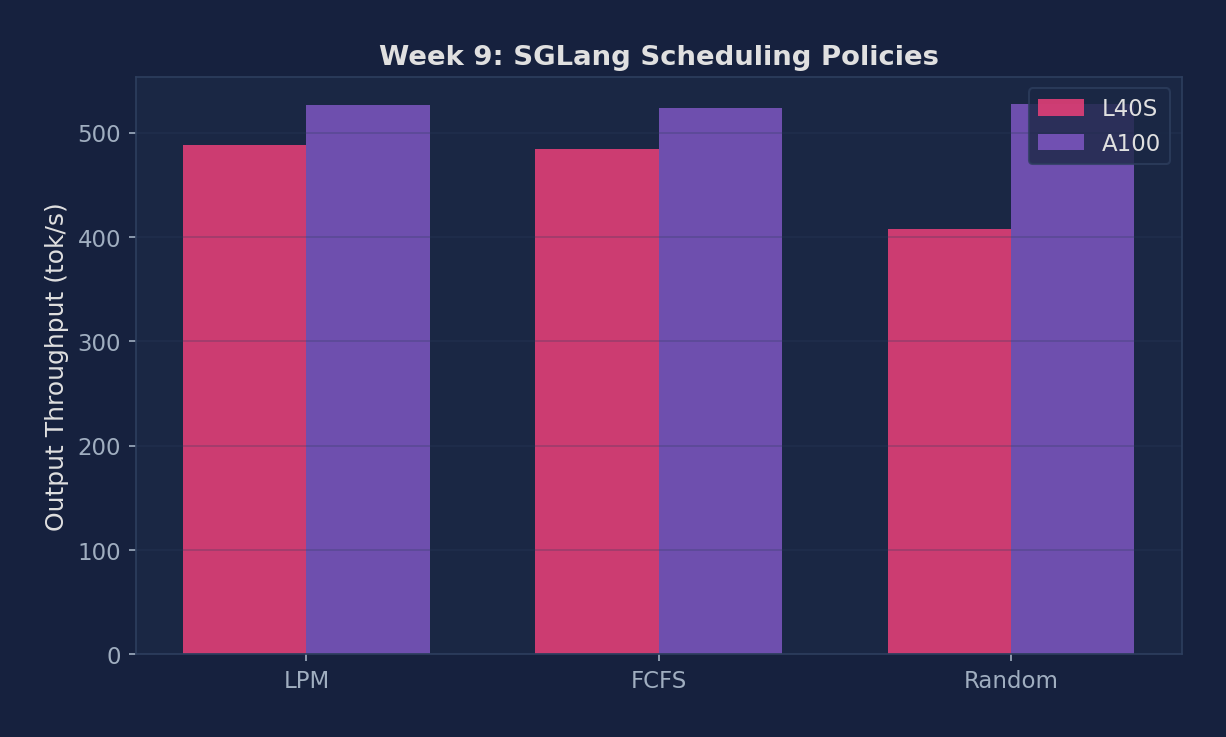
Figure 1: Throughput and TTFT per scheduling policy — LPM, FCFS, Random on L40S and A100 (ShareGPT workload)
Expected vs Actual
Expected
- On shared-prefix: LPM and DFS-weight should show significantly higher cache hit rates than FCFS (>50% vs ~10%)
- On ShareGPT (no shared prefix): all three policies should converge to similar performance
Actual Observations
- ShareGPT (L40S / A100): LPM, FCFS, and Random all give nearly identical results on ShareGPT — all three policies effectively become FCFS in disguise.
- Shared-prefix (H100, 2026-04-11): LPM reclaims a +6.5% throughput win over FCFS once a 200-token shared prefix is prepended.
- The L40S Random policy shows lower throughput (407 vs 484 tok/s) — likely due to one slow request stalling the batch.
Metrics to Collect
| Metric | Description | Unit |
|---|---|---|
| Cache hit rate per policy | Prefix cache token reuse on shared-prefix workload | % |
| TTFT p50, p99 | First-token latency under each scheduling policy | ms |
| Throughput per policy | Output tokens/s: FCFS vs LPM vs DFS-weight | tok/s |
| DP router gain | Cache-aware routing throughput vs. round-robin baseline | % |
| ITL p50 | Inter-token latency — should remain stable across policies | ms |
Source Code Reading
Files to Read
- sglang/srt/managers/scheduler.py — Core scheduling logic: the _get_next_prefill_batch method selects which waiting requests to run next. Find where FCFS, LPM, and DFS-weight diverge.
- sglang/srt/router/ — sglang_router: the cache-aware DP routing extension. Read how it computes prefix match scores per worker and routes requests accordingly.
- sglang/srt/mem_cache/radix_cache.py — Radix tree structure that enables O(prefix_length) lookup for LPM. Understanding this data structure explains the runtime cost of LPM vs FCFS.
What to Look For in the Source
Open the SGLang files listed above with your benchmark numbers in another tab — the connection between code path and measured metric becomes concrete. Three reading hooks are especially worth the effort:
sglang/srt/managers/schedule_policy.py — Where LPM / FCFS / Random Branch
Find the class that scores waiting requests against the radix tree. LPM sorts the waiting queue by matched_prefix_len per request (longer match → higher priority); FCFS sorts by arrival timestamp; Random shuffles. The branch is a small if self.policy == ... block — but the downstream consequence is the entire throughput delta you measured.
sglang/srt/mem_cache/radix_cache.py — Why LPM Lookup is Cheap
Look at match_prefix(). It walks the radix tree token-by-token until divergence — O(prefix_length), not O(num_cached_requests). This is why LPM scoring on a 10k-token waiting queue still costs <1ms and never shows up in the ITL numbers.
sglang/srt/router/ — Cross-Worker Cache Locality
The DP router computes a per-worker prefix match score by querying each worker's radix tree. The request is dispatched to the worker with the longest existing match. LPM works within a worker's queue; the router works across workers — they are orthogonal.
Written Analysis — Reference Answers
Below are reference answers based on the real measurements collected on PACE A100/L40S. Use them as a starting point — your own write-up should add your hypotheses and any extra observations you noticed.
Q1: Why are LPM and FCFS nearly identical on ShareGPT?
Observation: L40S: LPM 487.69 tok/s, FCFS 483.91 tok/s, Random 407.44 tok/s. A100: all three within 1% of each other. LPM and FCFS are statistically identical.
Why LPM degenerates to FCFS on ShareGPT: LPM (Longest Prefix Match) works by reordering the waiting queue to prioritize requests whose prefix is already cached in the radix tree. On ShareGPT, no two requests share their first 16+ tokens (random real-world conversations). So the radix tree is always empty for any new request — all requests have zero prefix match length. With all matches equal (zero), LPM degenerates to FCFS: it schedules in arrival order, identical to FCFS.
Q2: Why is Random scheduling worse on L40S than A100?
Observation: Random is 407.44 tok/s vs LPM/FCFS ~486 tok/s on L40S — a 16% deficit. On A100, all three are within 1%. Random is notably worse only on the slower GPU.
Mechanism: Random scheduling occasionally picks a very long prompt when there are shorter ones available. On L40S (slow GPU), a 2000-token prefill takes ~400ms — during which the GPU is locked in a single forward pass. Short requests that could have been served in 50ms total are delayed. On A100, the same 2000-token prefill takes ~80ms — fast enough that the stall barely affects overall throughput. The L40S exposes the worst-case Random scheduling behavior because stalls are long enough to statistically matter.
Q3: When does LPM win big in production?
LPM provides large gains (50%+ throughput) when:
- Few-shot evaluation: Each request starts with the same N demonstration examples. LPM sees that most of the waiting queue shares these cached example tokens and batches them together — all sharing the same KV cache blocks.
- Structured output generation: Requests sharing the same JSON schema prefix — LPM prioritizes schema-sharing requests, maximizing radix cache hits.
- RAG with shared document retrieval: Multiple users asking questions about the same document — LPM groups them together while the document KV is hot in cache.
When to NOT use LPM: If the workload has strict FCFS fairness requirements (SLA per-request, not per-batch), LPM can starve new unique requests by always preferring cached-prefix requests. Use FCFS for strict fairness guarantees.