Balanced Sparse Tree: A Scalable Network Topology for Large Language Models平衡稀疏樹:一種適用於大型語言模型的可擴展網路拓樸
After reading, you can explain how a block design lets each spine serve only δ ToRs while every ToR pair still shares one spine, and what that sparsity costs on 24 NPUs.讀完後,你能說明區組設計如何讓每台 spine 只服務 δ 台 ToR、而每對 ToR 仍共用一台 spine,以及這種稀疏在 24 顆 NPU 上的代價。
A two-tier Clos wires every ToR to every spine, so the spine radix caps the fabric. BST wires each spine to only ToRs of a group, and picks which ones with a block design in which every pair of ToRs shares exactly one spine. The group still acts as a full mesh of ToRs, two switch hops apart, and the spine ports saved serve more groups, so the fabric grows wider without a third tier. The price is one minimal path per ToR pair: skewed traffic needs detours through a third ToR, allowed only on lightly loaded ports (DiffR), and two virtual lanes prevent credit-loop deadlock. Measured only on 24 Ascend 910B NPUs with : HCCL AllReduce-Ring took 69.6 ms against 76.9 ms on Clos, All2All and AllReduce-NHR stayed within 0.5–2.4%, point-to-point traffic between two ToR halves was 1.38–2.59× slower than Clos on minimal paths and 1.03–1.60× with static detours, and Qwen3-30B-A3B inference stayed within 0.2–0.6% of Clos with spines of radix 2 instead of 4. Cost and scale claims are analysis and simulation.
兩層 Clos 把每台 ToR 接到每台 spine,所以 spine 的基數限制了網路規模。BST 讓每台 spine 只接一個群組中的 台 ToR,並以區組設計挑選是哪幾台,使每一對 ToR 恰好共用一台 spine。群組仍像 ToR 的全連接網,彼此相隔兩個交換器跳,省下的 spine 埠可服務更多群組,所以網路不加第三層也能變寬。代價是每對 ToR 只有一條最短路徑:偏斜的流量需要經第三台 ToR 繞路,而且只能走負載輕的埠(DiffR),另有兩條虛擬通道防止 credit 迴圈死結。實測只在 24 顆 Ascend 910B NPU、 上進行:HCCL AllReduce-Ring 用了 69.6 ms,Clos 是 76.9 ms;All2All 與 AllReduce-NHR 相差 0.5–2.4% 以內;兩半 ToR 之間的點對點流量在最短路徑下比 Clos 慢 1.38–2.59 倍,用靜態繞路時慢 1.03–1.60 倍;Qwen3-30B-A3B 推論與 Clos 相差 0.2–0.6% 以內,而 spine 的基數是 2 而非 4。成本與規模的主張來自分析與模擬。
1. Where this paper sits1. 這篇論文的位置
The Chapter 6, section 1 (Panel 2), derives the two-tier limit: a spine spends one port on every leaf, so radix caps the fabric at leaves and hosts, and the next step is a third tier with two more switch hops. Section 5 gives Dragonfly one hedged paragraph and notes that no paper in the primer uses it for LLM training. BST is a SIGCOMM paper that compares Clos, HyperX, Dragonfly+ and Zettafly on LLM collectives, though only in simulation. Rail-only deletes the spine and loses cross-rail paths, and ZCube moves the sparsity into multi-port NICs. BST leaves the NICs alone, keeps full reach, and makes the spine wiring sparse instead.
第 6.1 節(面板 2)推導兩層的上限:spine 在每台 leaf 上花一個埠,所以基數 把網路限制在 台 leaf、 台主機,再往上就要第三層、多兩個交換器跳。第 5 節只用保守的一段介紹 Dragonfly,並指出入門中沒有論文把它用在 LLM 訓練。BST 是一篇在 LLM 集體通訊上比較 Clos、HyperX、Dragonfly+ 與 Zettafly 的 SIGCOMM 論文,不過只在模擬中比較。Rail-only 刪掉 spine、失去跨 rail 的路徑,ZCube 把稀疏性移到多埠 NIC。BST 不改動 NIC、保留完整的觸及範圍,改讓 spine 的接線變稀疏。
2. The problem, in numbers2. 問題,用數字說明
The paper's motivation has no traffic measurement; it is analysis. LLM traffic is collectives (All2All, AllReduce), which favor symmetric fabrics, not arbitrary point-to-point flows. Each extra Clos tier adds switches, optics and hops, while direct graphs such as Dragonfly are asymmetric and sit far from the Moore bound, the largest network that a given degree and diameter allow ( nodes for degree at diameter 2). Switch radix stops at about 256. So the question is how many ToRs a spine port can serve. In a Clos stage the answer is one per spine port, and every ToR pair shares all the spines:
論文的動機沒有流量量測,而是來自分析。LLM 的流量是集體通訊(All2All、AllReduce),它們偏好對稱的網路,而不是任意的點對點流。Clos 每多一層就多出交換器、光模組與跳數,而 Dragonfly 這類直接圖不對稱,而且離 Moore 上限(給定度數與直徑時網路的最大規模;度數 、直徑 2 時為 個節點)很遠。交換器基數大約到 256 為止。所以問題是一個 spine 埠能服務幾台 ToR。在 Clos 的一級中,答案是每個 spine 埠一台,而每一對 ToR 共用全部的 spine:
3. The design3. 設計
3.1 One spine per ToR pair3.1 每對 ToR 一台 spine
BST is a two-level bipartite graph of spines (upper nodes) and ToRs (lower nodes). Each spine has degree inside a group of ToRs; the sparsity factor is 1 for a Clos stage. Read the spines as hyperedges over the ToRs. The rule is that every pair of ToRs in a group lies in exactly one hyperedge: a Steiner system, or balanced incomplete block design. Then each pair has one deterministic two-hop path with no hash choice, and collective load spreads evenly. Construction has four steps, which Figure 3 of the paper shows for , :
BST 是由 spine(上層節點)與 ToR(下層節點)構成的兩層二分圖。每台 spine 在一個 台 ToR 的群組中度數為 ;稀疏係數 在 Clos 的一級中為 1。把 spine 看成 ToR 上的超邊。規則是群組中每一對 ToR 恰好落在一條超邊裡:這是 Steiner 系統,也就是平衡不完全區組設計。於是每一對都有一條確定的兩跳路徑,不需雜湊選擇,集體通訊的負載也平均分散。建構分四步,論文 Figure 3 以 、 示範:
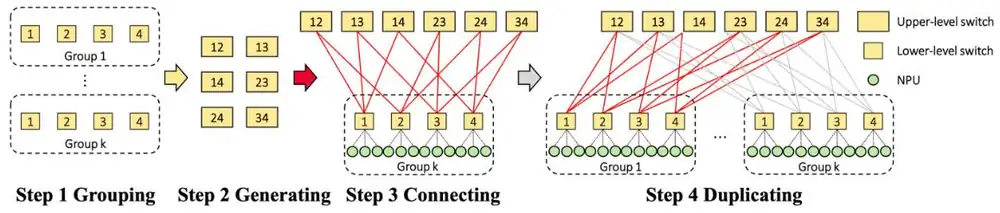
With (the paper's Hiddenfly) every pair gets its own spine. A -merge combines pairwise spines into larger blocks: , and become , and seven ToRs end with the seven blocks of the Fano plane. Counting each ToR's blocks and all blocks of a group gives
(論文稱為 Hiddenfly)時,每一對都有自己的 spine。-合併把成對的 spine 合成更大的區組:、 與 合成 ,七台 ToR 最後得到 Fano 平面的七個區組。計算每台 ToR 所屬的區組數與一個群組的區組總數,得到
where is each ToR's uplink count and the spines per group. Both must be integers. For that gives and , so a design exists only if or : 7, 9, 13, 15 and so on. Finding a merge in general is an exact clique-cover problem.
其中 是每台 ToR 的上行數, 是每個群組的 spine 數。兩者都必須是整數。 時即 與 ,所以只有 或 時設計才存在:7、9、13、15 等等。一般情況下找合併是精確團覆蓋問題。
3.2 How wide it grows3.2 它能長多寬
A spine with radix spends ports per group, so it serves groups. Theorem 1 counts the ToRs when a merge exists for :
基數 的 spine 每個群組花 個埠,所以能服務 個群組。當 的合併存在時,定理 1 數出 ToR 數:
Our worked example uses 64-port switches with 32 NPU ports and 32 uplinks per ToR, one question per row. Every BST row keeps the two-tier path of 3 switches:
我們的算例用 64 埠交換器,每台 ToR 32 個 NPU 埠、32 條上行,逐列計算如下。每一列 BST 都保持兩層的 3 台交換器路徑:
| Question問題 | Calculation算式 | Result結果 |
|---|---|---|
| Two-tier Clos, 3 switches兩層 Clos,3 台交換器 | NPUs | |
| Three-tier Clos, 5 switches三層 Clos,5 台交換器 | NPUs | |
| BST, : , groupsBST,:, 個群組 | NPUs528 spines528 台 spine | |
| BST, with BST,、 | no design不存在設計 | |
| BST, as two spine planes of 16: , 21 groupsBST,、兩個各 16 條的 spine 平面:,21 個群組 | NPUs1 spine port idle每台 spine 閒置 1 埠 |
Larger is not automatically larger: number theory decides which exist, and the paper states the choice of as an optimization (its Problem 1). Adding spine planes in proportion to ToR uplinks is the paper's spine-fabric scaling. From such analysis the authors claim a three-tier Clos's scale at about half its cost and 1.7× Zettafly's scale; those are analysis results, not measurements.
越大不一定越大:哪些 存在由數論決定,論文把 的選擇寫成最佳化問題(Problem 1)。按 ToR 上行的比例增加 spine 平面,是論文的 spine 層擴充。作者根據這類分析主張以約一半的成本達到三層 Clos 的規模、並達到 Zettafly 的 1.7 倍規模;這些是分析結果,不是量測。
3.3 Routing a sparse fabric: DiffR3.3 在稀疏網路上選路:DiffR
One shared spine per ToR pair means one minimal path. For skewed traffic, a ToR may use a detour through a third ToR: ToR, spine, ToR, spine, ToR, 4 links instead of 2. Detours cost capacity under uniform traffic. In the paper's 4-ToR full-mesh example of All2All, each link with detours carries 5 flows of 3 types, so a pair gets
每對 ToR 共用一台 spine,代表只有一條最短路徑。遇到偏斜的流量,ToR 可以經第三台 ToR 繞路:ToR、spine、ToR、spine、ToR,共 4 條鏈路而非 2 條。在均勻流量下,繞路會耗掉容量。論文以 4 台 ToR 的全連接網示範 All2All:加上繞路後每條鏈路承載 3 類共 5 條流,所以一對得到
DiffR (differentiated routing) therefore gates detours with a threshold below , the PFC threshold or port buffer (or below the maximum credit count). A port whose queue is below carries minimal and detour traffic; otherwise only minimal traffic. Locally, a ToR skips detour ports that are busy. Remotely, a ToR whose downstream queue passes tells its upstream ToRs, which stop detouring through it to the congested destinations. The paper recommends or , with packet spraying.
因此 DiffR(差異化路由)以低於 (PFC 門檻或埠緩衝)的門檻 控制繞路(或以低於最大 credit 數的 )。佇列低於 的埠可承載最短路徑與繞路流量;否則只承載最短路徑流量。在本地,ToR 會略過忙碌的繞路埠。在遠端,下游佇列超過 的 ToR 會通知上游 ToR,讓它們停止經它繞往受影響的目的地。論文建議 或 ,並搭配封包噴灑。
3.4 Deadlock and collectives3.4 死結與集體通訊
Minimal flows go strictly up, then down, so they form no cycle; the paper proves that a credit-loop deadlock needs at least three detour flows. The fix is two virtual lanes per port: a detour that enters a ToR from a spine and leaves toward another spine moves to VL2 and stays there. For collectives, BST prefers one-shot All2All, where each NPU sends to all others at once, and runs AllReduce as two All2All rounds. Ring AllReduce needs rank placement: HCCL's Ranktable lays out six congestion-free rings over four ToRs.
最短路徑的流嚴格先上後下,所以不會形成迴圈;論文證明 credit 迴圈死結至少需要三條繞路流。解法是每個埠兩條虛擬通道:從 spine 進入 ToR 再往另一台 spine 離開的繞路流改走 VL2,並一直留在 VL2。在集體通訊上,BST 偏好一次發送的 All2All(每顆 NPU 同時送給所有其他 NPU),並把 AllReduce 做成兩輪 All2All。環狀 AllReduce 需要 rank 擺放:HCCL 的 Ranktable 在四台 ToR 上排出六個無壅塞的環。
4. Implementation4. 實作
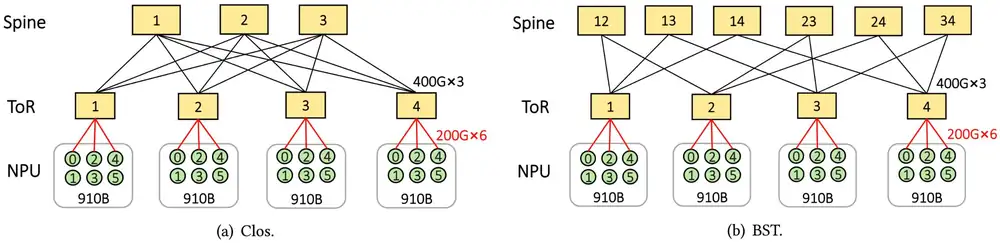
Simulations use Netisim, the authors' in-house packet simulator with spraying, ECMP and DiffR, cross-checked on the open-source Open-usim; the paper gives no line counts. The testbed has 4 Ascend 910B servers, 6 of 8 NPUs used in each (24 NPUs), each NPU on a 200G port to its ToR. The switches have 32 ports of 400G and are split into logical switches by VPN-based port isolation. Clos uses 3 spines that each reach all 4 ToRs; BST is bst(4,2,1), 6 spines named after ToR pairs. Current switches cannot run DiffR, so detours are static routing-table entries; hardware DiffR is planned for next-generation chips. Tests use the HCCL test tool and the MindIE inference engine.
模擬使用 Netisim,作者自行開發的封包模擬器,支援噴灑、ECMP 與 DiffR,並在開源的 Open-usim 上交叉驗證;論文沒有給出程式行數。測試平台有 4 台 Ascend 910B 伺服器,每台用 8 顆 NPU 中的 6 顆(共 24 顆),每顆 NPU 以一個 200G 埠接到它的 ToR。交換器有 32 個 400G 埠,以 VPN 式的埠隔離切成邏輯交換器。Clos 用 3 台各接全部 4 台 ToR 的 spine;BST 是 bst(4,2,1),6 台以 ToR 配對命名的 spine。現有交換器無法執行 DiffR,所以繞路是靜態路由表項;硬體 DiffR 預計放進下一代晶片。測試使用 HCCL 測試工具與 MindIE 推論引擎。
5. What was measured5. 量到了什麼
All hardware results come from this 24-NPU testbed with . Collectives (Table 3 of the paper) move 1 GB, averaged over 1,000 iterations; Clos uses the default Ranktable and BST a load-balanced one:
所有硬體結果都來自這個 的 24 顆 NPU 測試平台。集體通訊(論文 Table 3)搬移 1 GB,取 1,000 次迭代的平均;Clos 用預設的 Ranktable,BST 用負載平衡的 Ranktable:
| HCCL test, 24 NPUs, 1 GB | HCCL 測試,24 顆 NPU,1 GB | Clos (µs) | BST, minimal (µs) | BST,最短路徑(µs) | BST vs Clos | BST 對 Clos |
|---|---|---|---|---|---|---|
| All2All-Pairwise | 36,793 | 37,676 | +2.4% | |||
| AllReduce-NHR | 74,407 | 74,755 | +0.5% | |||
| AllReduce-Ring | 76,914 | 69,648 | −9.4% |
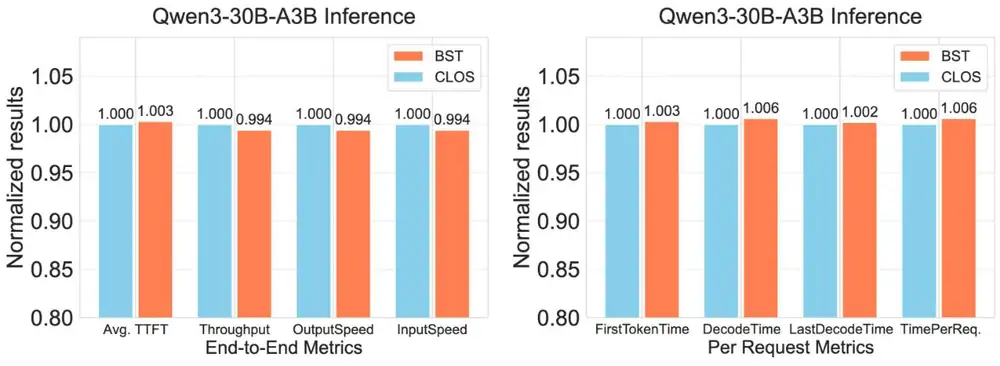
The paper credits the faster ring to fewer ECMP hash collisions on BST's unique paths. Note that the two fabrics also ran different Ranktables. For inference, Qwen3-30B-A3B (128 experts, TP and EP across two servers, oasst1 prompts) ran on MindIE with differentiated routing enabled:
論文把環較快歸因於 BST 唯一路徑上的 ECMP 雜湊碰撞較少。要注意兩個網路用的 Ranktable 也不同。推論方面,Qwen3-30B-A3B(128 個專家、TP 與 EP 跨兩台伺服器、oasst1 提示)在 MindIE 上執行,並開啟差異化路由:
Point-to-point traffic exposes the sparsity. The authors split the 4 ToRs into two groups of two and let 50%, 75% or 100% of the NPUs send to the other group (Table 4). Clos stays near 26.3–27.0 ms. The slowdowns, one question per row:
點對點流量會暴露稀疏性。作者把 4 台 ToR 分成兩組各兩台,讓 50%、75% 或 100% 的 NPU 送往另一組(Table 4)。Clos 維持在約 26.3–27.0 ms。減速逐列計算如下:
| Question問題 | Calculation算式 | Result結果 |
|---|---|---|
| 50% sending: minimal; static detour50% 發送:最短路徑;靜態繞路 | ||
| 75% sending: minimal; static detour75% 發送:最短路徑;靜態繞路 | ||
| 100% sending: minimal; static detour100% 發送:最短路徑;靜態繞路 |
Why detours cannot reach 1.0× at full load: count the spine links that cross between the two halves. In Clos each of 3 spines has 2 links on each side, 6 in all. In bst(4,2,1) only spines 13, 14, 23 and 24 join both halves, 4 links; spines 12 and 34 stay inside one half. At 100% load the cut bound is , and the measured 1.60× sits just above it.
為什麼滿載時繞路也到不了 1.0 倍:數一數跨越兩半的 spine 鏈路。Clos 中 3 台 spine 每台在每一側有 2 條鏈路,共 6 條。bst(4,2,1) 中只有 spine 13、14、23 與 24 連接兩半,共 4 條;spine 12 與 34 都在同一半之內。100% 負載時切口下界是 倍,實測的 1.60 倍恰好在它上方。
The panel below generalizes this count to other . Minimal routing can be worse than the cut bound when the pairs are unbalanced: if each sending ToR talks to one ToR only, it uses one of its three uplinks. The measured minimal-path slowdowns lie between the balanced and the one-partner bounds. Everything else in the evaluation is simulation: Netisim at 320 and 2,560 NPUs, where BST is reported 3.9–13.4% better than other topologies; this page does not show those numbers.
下面的面板把這個計數推廣到其他 。配對不平衡時,最短路徑可能比切口下界更差:如果每台發送的 ToR 只和一台 ToR 通訊,它只用到三條上行中的一條。實測的最短路徑減速落在平衡與單一夥伴兩個下界之間。評估的其餘部分都是模擬:320 與 2,560 顆 NPU 的 Netisim,其中報告 BST 比其他拓樸好 3.9–13.4%;本頁不展示這些數字。
Switch to , . Why does balanced minimal routing now sit above the detour bound, when for the two lines coincide? Look at how a spine with four ToRs can fall across the cut.
切換到 、。為什麼平衡的最短路徑現在落在繞路下界之上,而 時兩條線重合?想想一台接四台 ToR 的 spine 可以怎樣橫跨切口。
6. Limits and open questions6. 限制與未解的問題
- What was built. The hardware BST is over 4 ToRs, the pairwise case that OFT and MLFM already describe. No Steiner design with and no full DiffR ran on hardware; detours were static routes.實際建了什麼。硬體上的 BST 是 4 台 ToR、,也就是 OFT 與 MLFM 早已描述的成對情況。 的 Steiner 設計與完整的 DiffR 都沒有在硬體上執行;繞路是靜態路由。
- Confounds and scale. The Ring result compares different Ranktables. The testbed has 24 NPUs; everything larger is simulation with one 8-NPU server model, and no comparison with rail-optimized Clos or rail-only is given.干擾因素與規模。環的結果比較的是不同的 Ranktable。測試平台只有 24 顆 NPU;更大的一切都是使用單一 8 顆 NPU 伺服器模型的模擬,也沒有與 rail-optimized Clos 或 rail-only 比較。
- Sparsity costs. Adversarial P2P loses bandwidth (Table 4), collectives need topology-aware placement, and number theory restricts , which complicates expansion and strands some ports.稀疏的代價。對抗性的點對點會損失頻寬(Table 4),集體通訊需要感知拓樸的擺放,而數論限制了 ,讓擴充變複雜、也會閒置部分埠。
- Dependencies and review. Detours rely on PFC or credit-based lossless fabrics, and interaction with congestion control is not evaluated. The appendix, including the pair-bandwidth derivation and deployment examples, is not peer-reviewed.依賴與審查。繞路依賴 PFC 或 credit 式的無損網路,與壅塞控制的互動沒有評估。附錄(包括配對頻寬的推導與部署範例)未經同儕審查。
7. How it connects7. 與其他內容的關聯
- Chapter 6: section 1's limit is what BST raises at the same hop count; section 5's Dragonfly paragraph now has an LLM-era comparison, in simulation.第 6 章:BST 在相同跳數下提高的正是第 1 節的 上限;第 5 節的 Dragonfly 段落現在有了 LLM 時代的比較(在模擬中)。
- ZCube also cuts Clos cost with a two-level static fabric, but by search and multi-port NICs. Rail-only removes cross-rail reach, which BST keeps.ZCube 也以兩層靜態網路降低 Clos 的成本,但靠的是搜尋與多埠 NIC。Rail-only 拿掉跨 rail 的觸及,BST 則保留它。
- DiffR builds on ECMP and spraying (Chapter 8) and on PFC (Microsoft RoCE); the Ranktable rings are the rank placement of the Chapter 4.DiffR 建立在 ECMP 與噴灑(第 8 章)以及 PFC(Microsoft RoCE)之上;Ranktable 的環就是第 4 章中的 rank 擺放。
Key numbers關鍵數字
| Number | 數字 | Meaning and setup | 意義與設定 |
|---|---|---|---|
| 69.6 vs 76.9 ms | HCCL AllReduce-Ring, BST vs Clos (24 NPUs, 1 GB; measured) | HCCL AllReduce-Ring,BST 對 Clos(24 顆 NPU、1 GB;實測) | |
| +0.5% / +2.4% | AllReduce-NHR / All2All-Pairwise, BST vs Clos (same; measured) | AllReduce-NHR / All2All-Pairwise,BST 對 Clos(同上;實測) | |
| 1.38–2.59× / 1.03–1.60× | P2P between two ToR halves vs Clos, minimal / static detours (measured) | 兩半 ToR 之間的點對點對 Clos,最短路徑 / 靜態繞路(實測) | |
| 0.2–0.6% | Qwen3-30B-A3B inference deviation from Clos, spine radix 2 vs 4 (measured) | Qwen3-30B-A3B 推論與 Clos 的差距,spine 基數 2 對 4(實測) | |
| Group sizes for which a design exists (analysis) | 設計存在的群組大小(分析) | ||
| 0.6 BW | Pair rate with forced detours in the 4-ToR All2All example (analysis) | 4 台 ToR 的 All2All 例子中強制繞路時的每對速率(分析) |
Terms used on this page本頁用到的術語
- BST
- Balanced Sparse Tree: two switch levels where each spine joins ToRs of a group and every ToR pair shares one spine.
- 平衡稀疏樹:兩層交換器,每台 spine 接一個群組中的 台 ToR,每對 ToR 共用一台 spine。
- Steiner system / block design
- Blocks of points such that every pair of points lies in exactly one block.
- 由 個點組成的區組,使每一對點恰好落在一個區組中。
- Hiddenfly / -merge
- The case with one spine per pair / merging pairwise spines into larger blocks.
- 每對一台 spine 的 情況 / 把成對的 spine 合併成更大的區組。
- DiffR
- Minimal paths always; detours through a third ToR only on ports with queues below .
- 永遠走最短路徑;只有在佇列低於 的埠才經第三台 ToR 繞路。
- Virtual lane
- A separate buffer and credit class on a port; BST moves detours to VL2.
- 埠上獨立的緩衝與 credit 類別;BST 把繞路流移到 VL2。
- Ranktable
- HCCL's map from collective ranks to devices.
- HCCL 中集體通訊 rank 對應到裝置的表。